

Do you like our articles? Support Seven Geek Sama via Patreon and benefit from advantages such as access to our articles 24 hours in advance!
25 years ago, in the fall of 2001, was released on French screens, Moulin Rouge! by Baz Luhrmann. First presented out of competition and at the opening ceremony of the 54th Cannes Film Festival the previous spring, this film marked the 2000s and was a milestone in the director's career.
Summary
A simple story driven by a frantic pace
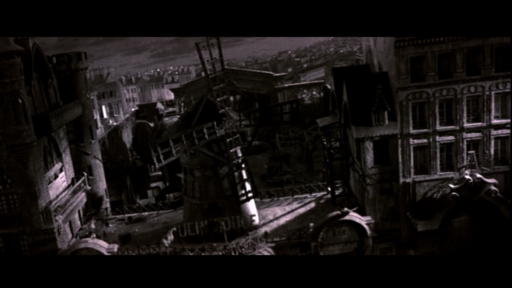
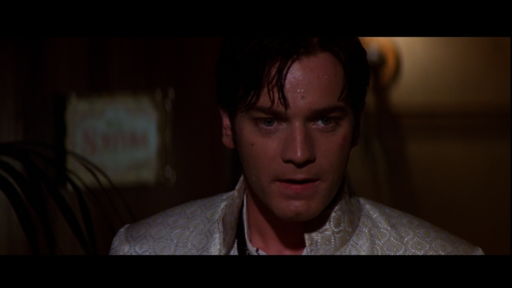
Moulin Rouge! opens with a scene of desolation in dark colors, we discover Christian (Ewan McGregor) in a state of depression, in voice-over he immediately reveals to us that his love, Satine (superbly played by Nicole Kidman) is dead, and takes us back a year.
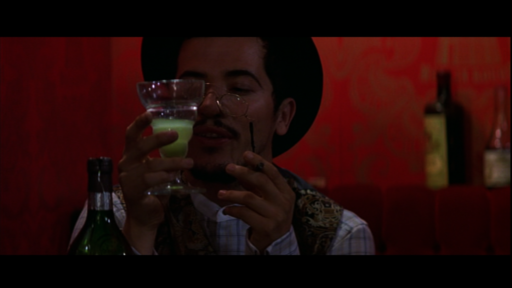
We then discover a Christian who has recently arrived in Paris from his native England to pursue a career as a writer in the French capital which he sees as the center of his bohemian ideals. After befriending other artists, including Erik Satie (Matthew Whittet) and Toulouse-Lautrec (John Leguizamo), he meets Satine at the Moulin Rouge and the two fall in love.
Only Satine is a courtesan on whom a Duke (brilliantly played by Richard Roxburgh) has pretensions and threatens the Moulin Rouge, in which he invests heavily, if Satine does not spend a night with him.
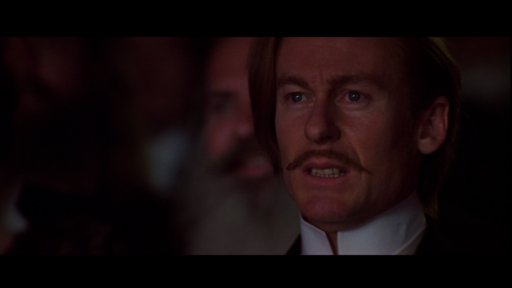
Christian also develops an unhealthy jealousy at the idea of Satine selling her charms to the Duke and to top it off, tuberculosis gets involved!
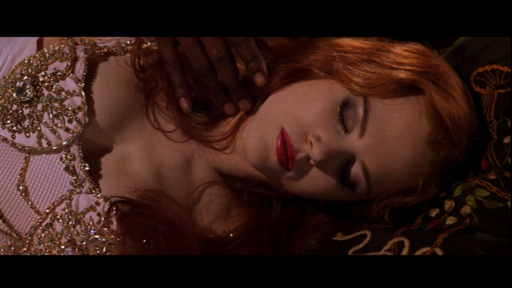
This story, which may seem simplistic at first glance, is enhanced by the very genre of the film: the musical film. We deliberately choose not to speak of “musical comedy” because we believe that this Franco-French designation is reductive when it comes to musical Movies, after all certain works like Les Miserables by Tom Hooper, have absolutely nothing comical about them. And although Moulin Rouge! is full of humorous scenes, it nonetheless remains a tragedy.
Part of the tradition of musical Movies which deploy a flamboyant aesthetic and precise staging to dazzle the spectators, Moulin Rouge! explodes with shimmering and saturated colors, predominantly red and blue, to represent cabaret and the world of the night. Carried by a syncopated montage of short shots, we are caught in the whirlwind of the protagonists' tumultuous love, the disjointed narration highlighting the frenzy of a festive life with devastating consequences. Moulin Rouge! warns us from the start: do not trust the illusion of lights, they are ephemeral.
A film with drawers
Like other musical Movies like Let's sing in the rain by Stanley Donen and Gene Kelly, meta film which traces the transition from silent cinema to talkies in Hollywood at the end of the 1920s, Moulin Rouge! is a film that looks in its rearview mirror.
Starting with its original soundtrack featuring 20th century classics, from The lament of the mound from Jean Renoir to Smells Like Teen Spirit from Nirvana, through Your Song by Elton John. Special mention must be made to Scottish composer Craig Armstrong for the soundtrack. The choice of pre-existing songs still echoes Let's sing in the rain including the eponymous song Singin’ in the rain, was already a classic when the film was released in 1951.

Besides music, Moulin Rouge! which is freely inspired by The Lady of the Camellias by Alexandre Dumas-fils, is also reminiscent of other Movies that preceded it, perhaps this is due to the durability of the themes it addresses. Starting with The Red Slippers by Michael Powell and Emeric Pressburger, where a ballerina with hair as flamboyant as Satine is torn between a composer with whom she shares a romantic relationship and her impresario who demands rigor and hours of rehearsals.
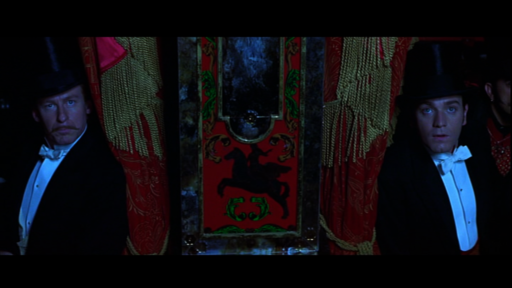
Other references are completely assumed, like this passage in the very first scene taking place in the cabaret where Satine intones Diamonds Are a Girl’s Best Friend formerly sung by Marilyn Monroe in Men prefer blondes by Howard Hawks. The heroine of Moulin Rouge! also covers Rita Hayworth's legendary striptease in Gilda by Charles Vidor, removing his gloves and brandishing them above her. In doing so, the film elevates him to the rank of icon among the greatest Hollywood stars of the 20th century which has not yet begun in the diegesis.
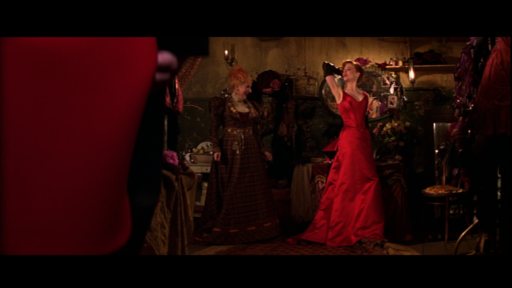
And intrinsically, it is these numerous references, these eternal themes which have given Moulin Rouge! its status as a classic upon its release, since each viewing brings new elements that may have previously escaped us due to incomplete knowledge.
The place of Moulin Rouge! in the career of Baz Luhrmann

Before Moulin Rouge! Australian director Baz Luhrmann had two Movies to his credit, Strictly Ballroom And Romeo + Juliet. Moulin Rouge! being the conclusion of a trilogy he called The Red Curtain Trilogy where the three Movies fully assume their theatricality and their relationship to the performing arts. With dance for Strictly Ballroom, the Shakespearean verse for Romeo + Juliet, and singing and dancing for Moulin Rouge!. The first two parts of this trilogy already have what is Baz Luhrmann's trademark, ultra-fast editing giving a dramatic dizziness to his works (an artifice that we find in Australia).
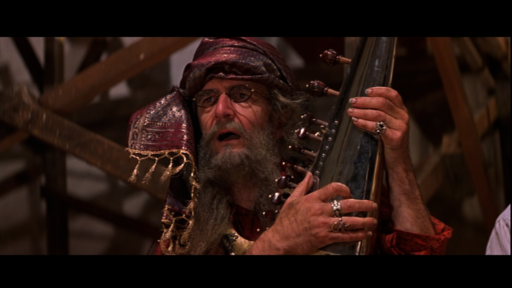
But these are The Great Gatsby And Elvis which are the Movies that have the most in common plastically with Moulin Rouge!, if indeed we are tempted to wonder if he did not want to recreate the magic of the latter with all his Movies since.
The hint of flamboyance dear to Baz Luhrmann serves perfectly in the adaptation of F. Scott Fitzgerald's classic, The Great Gatsby, since this work is a testimony to the excitement of the 1920s, renamed “The Roaring Twenties” later in the 20th century and lends itself perfectly to the excess that we find in the director’s works. Moreover, this unleashing of artifice offers a striking contrast with the tragedy of this fable about the American dream, just as is the case with Moulin Rouge!.

Conversely, for Elvis, if this escalation further highlights the electrifying presence of the singer on his audience, it is less in keeping with the exercise of the biopic as it is. Indeed, although the artist is himself a colorful character, the means used to reveal his story fall into the superfluous, since Elvis is sufficient in himself and the scintillating flow that we find in Moulin Rouge! here harms the intimacy of the character. We also do not find the tragic aspect which allows us to counterbalance the delirious canvas of The Great Gatsby Or Moulin Rouge!.

Eventually…
Moulin Rouge! by Baz Luhrmann is 25 years old and hasn't aged a bit and we realize, after a quarter of a century, that it is perhaps the manifest film of an author-director who does not sacrifice his narrative codes on the altar of Hollywood conformism.